
Why do surveys keep disqualifying me?

The fundamental reason behind constant disqualification frustrates most survey takers: you are encountering the inherent mathematics of market research targeting.
The targeting reality:
Research companies don't need opinions from everyone, they need opinions from specific people. A pharmaceutical company testing arthritis medication marketing needs respondents aged 50+ with diagnosed arthritis who currently take prescription medication. If you are 28 years old and healthy, you are immediately disqualified no matter how interested you are in participating.
Each survey has defined quotas. A study might need exactly 200 responses broken down as: 50 males aged 18-24, 50 females aged 18-24, 50 males aged 25-34, 50 females aged 25-34. Once a quota cell fills, everyone else in that demographic gets rejected even if they perfectly match requirements.
The disqualification math:
Survey platforms invite 10-20 times more people than needed to ensure quotas fill. If a study needs 200 completions, the platform might invite 2,000 people. This means 90% of invitees will face rejection regardless of their demographics or survey-taking skills. The system deliberately over-invites to account for:
- People who don't respond to invitations.
- Respondents who fail quality checks.
- Participants who abandon surveys mid-completion.
- Quota cells that fill during the fielding period
Key rule: Disqualification is built into the business model. Even perfect survey takers with ideal demographics expect 70-80% rejection rates. This isn't personal failure, it is statistical necessity.
What makes you get disqualified from surveys?
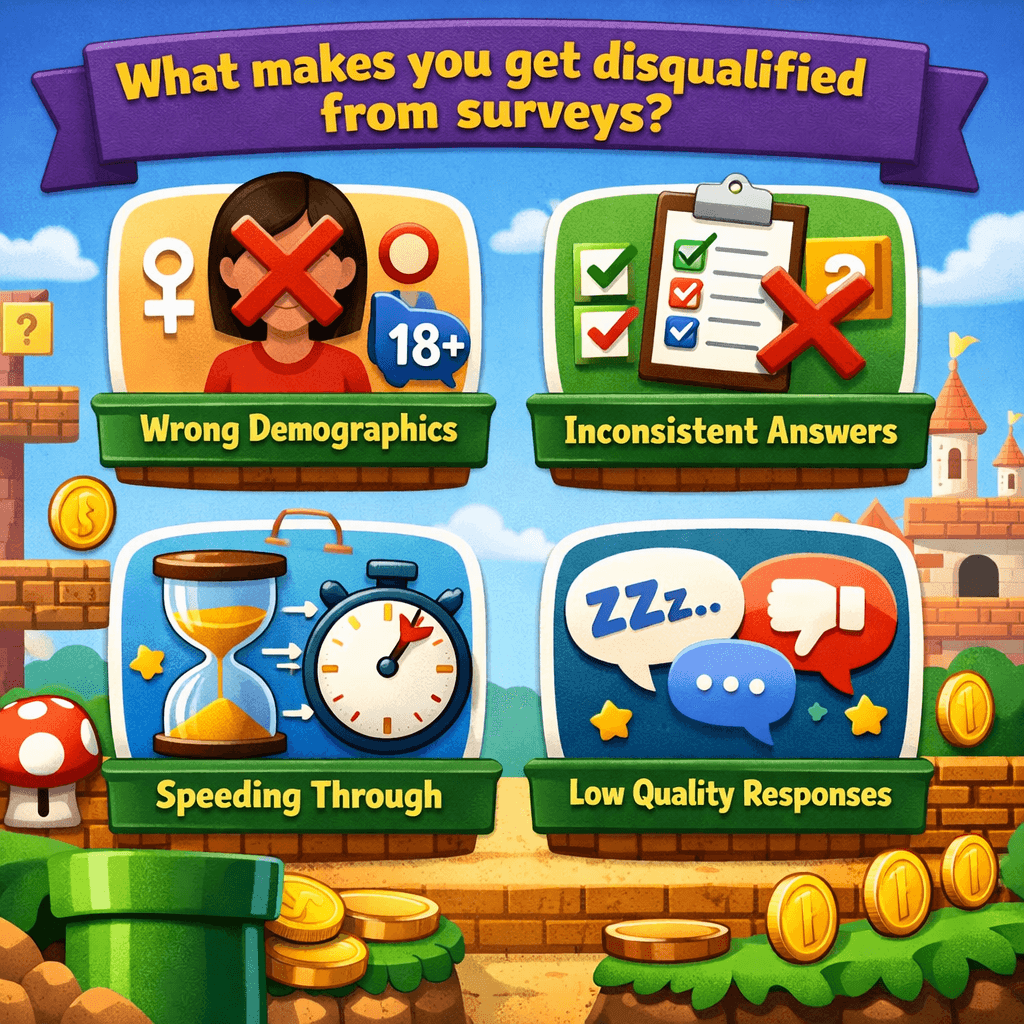
Understanding specific survey disqualification reasons helps you recognize what is within versus outside your control.
Demographic Mismatch
The most common reason: Your age, gender, location, income, or other demographic factors don't match study requirements.
Research targeting mothers aged 25-40 with children under 5 disqualifies everyone else, single people, empty nesters, fathers, younger/older women. You can't change these factors, making demographic disqualification unavoidable when you are not the target.
Why demographic mismatches dominate:
Studies need statistical validity within specific populations. A baby formula manufacturer only cares about opinions from parents actively feeding infants formula. They don't need feedback from pregnant women planning to breastfeed, parents of older children, or non-parents.
Quota Fulfillment
What happens: You match all demographic requirements perfectly, but your specific demographic cell already filled its quota.
A study might need 100 total responses with specific breakdowns by age and gender. If the "males aged 18-24" cell filled an hour ago, every subsequent male in that age range gets disqualified regardless of perfect qualification.
The timing element:
First responders have higher qualification rates. Surveys fielding for days or weeks see declining qualification rates as quotas fill. Checking for new surveys multiple times daily improves odds by increasing your chances of catching fresh studies.
Behavioral Exclusions
Common excluders:
- Participation frequency: "You completed a similar survey recently" (prevents overexposure).
- Category conflicts: Recent surveys about competing products (prevents bias).
- Professional exclusions: Working in market research, advertising, journalism, or the product category being studied.
- Sensitive topics: Legal issues, employment with specific companies, financial situations
Example scenario:
You completed an iPhone satisfaction survey last week. This week, a Samsung research project disqualifies you because you are too recently engaged with a competitor. Both companies want respondents who haven't been primed by recent competitive product surveys.
Response Quality Flags
What triggers quality concerns:
- Speeding: Completing screener questions faster than humanly possible to read them.
- Straightlining: Selecting the same answer choice for every question in a grid.
- Inconsistent responses: Contradicting yourself within the same survey.
- Attention check failures: Missing embedded verification questions ("Please select 'Strongly Agree' for this question").
- Impossibility patterns: Claiming behaviors that can't coexist (e.g., "Never watches TV" but "Watches 4+ hours daily").
Common mistake: Rushing through surveys to maximize completions per hour. This triggers quality flags and reduces future qualification rates as platforms tag your account as low-quality.
Profile Inconsistencies
The tracking problem:
Survey platforms maintain profile data across all surveys you complete. If you said you are 32 years old in January but claim to be 28 in March, systems flag your account for inconsistency. If you indicated no children in one survey but claim three kids in another, you are marked as unreliable.
Why consistency matters:
Researchers pay premium rates for reliable panel data. Respondents who contradict themselves create data quality issues. Platforms protect their reputation by restricting inconsistent respondents' access to surveys.
Why do I fail survey screenings repeatedly?

Repeated failure typically indicates demographic mismatch with available survey inventory rather than personal failing.
The inventory composition reality:
Survey platforms don't offer equal distribution across all demographics. Available surveys skew toward certain profiles:
High-demand demographics (more opportunities):
- Ages 25-54 (prime consumer spending years).
- Household decision-makers.
- Middle to upper-middle income brackets ($40,000-150,000 annually).
- Parents with children at home.
- Employed full-time.
- Urban and suburban locations.
- Active category users (frequent shoppers, travelers, technology adopters)
Lower-demand demographics (fewer opportunities):
- Ages 18-24 and 65+ (narrower purchasing power).
- Non-decision-makers.
- Very low or very high income extremes.
- Single individuals without children.
- Unemployed, retired, or students.
- Rural locations.
- Infrequent category users
If your demographics fall outside high-demand categories, you will naturally experience higher disqualification rates through no fault of your own.
The geographic factor:
US-based survey takers have more opportunities than international users. Within the US, major metropolitan areas see more surveys than rural regions. National brands need representative samples, but regional studies target specific cities or states, limiting geographic eligibility.
The behavior matching:
Studies often target specific behaviors: recent car purchasers, frequent restaurant diners, vacation planners, insurance shoppers, healthcare decision-makers. If you don't engage in these behaviors regularly, you will fail behavioral screeners consistently.
If you are consistently disqualified across multiple platforms and survey types, the issue is likely demographic fit with available research rather than your survey-taking approach. Consider focusing your time on platforms that better match your profile.
How can I qualify for more paid surveys?
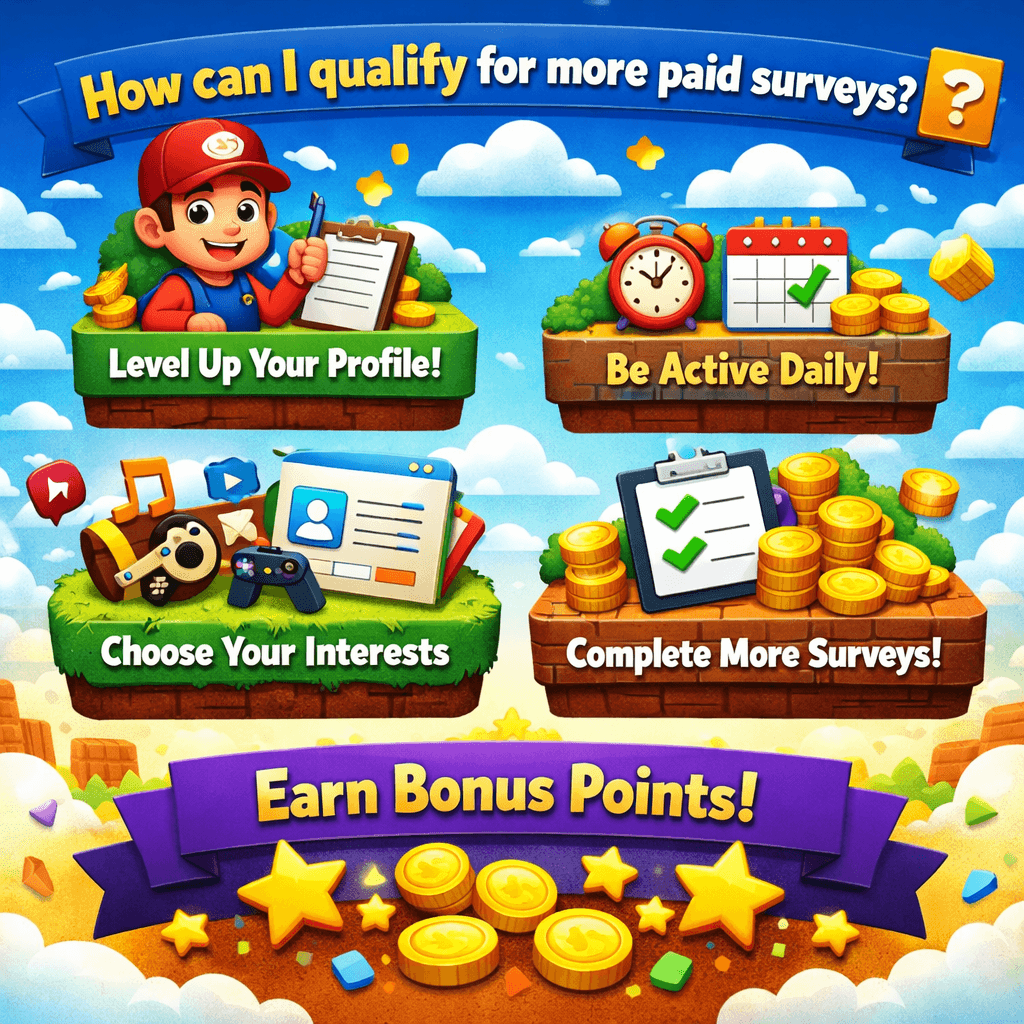
Improving qualification rates requires strategic approaches within your control:
Complete Your Profile Thoroughly
Why profiles matter:
Survey platforms use profile data to pre-screen survey invitations. Detailed profiles reduce mismatched invitations, saving your time by only presenting surveys where you might qualify.
What to complete:
- Core demographics: Age, gender, location, household size, marital status.
- Household details: Number and ages of children, pet ownership, home ownership vs. renting.
- Financial information: Income range, employment status, job industry.
- Technology usage: Devices owned, internet services, streaming subscriptions.
- Shopping behaviors: Purchase frequency in various categories, brand preferences.
- Health information: General wellness, chronic conditions, insurance status.
- Lifestyle interests: Hobbies, activities, media consumption.
The completeness paradox:
More detailed profiles mean fewer invitations, but higher qualification rates on received invitations. It is better to receive 10 invitations with 30% qualification than 50 invitations with 5% qualification, you will complete more surveys with less time wasted.
Answer Consistently Across All Surveys
The consistency imperative:
Platforms track your responses across surveys indefinitely. Contradicting previous answers raises fraud flags even if contradictions are innocent mistakes or life changes.
Consistency checklist:
- Use the same age/birthdate on every platform and survey.
- Report consistent income ranges (adjust annually, not survey-to-survey).
- Maintain consistent employment status unless genuinely changed.
- Keep household composition stable (don't randomly add/remove family members).
- Use consistent location information.
- Report stable shopping behaviors unless genuinely shifted.
Handling legitimate changes:
If your situation actually changes (new job, moved cities, had a baby), update your profile immediately across all platforms you use. This creates a documented change rather than appearing as inconsistent responses.
Take Screeners at a Natural Pace
The speed sweet spot:
Reading a question and selecting an answer takes 3-8 seconds depending on complexity. Completing screeners faster than this triggers speeding flags. Taking dramatically longer suggests distraction or survey fatigue.
Quality signaling through timing:
- Read each question completely before answering.
- Take 4-6 seconds per straightforward question.
- Spend 8-12 seconds on complex questions with multiple options.
- Pause naturally between question pages.
- Avoid rhythm clicking (selecting answers at perfectly regular intervals).
The attention they are paying:
Platforms measure time per question, total survey time, time between surveys, and response patterns. Maintaining natural human variability in these metrics signals genuine engagement.
Update Profiles When Life Changes
Major life events that affect qualification:
- Job changes (employment status, income, industry).
- Moving to new location (city, state, zip code).
- Household changes (marriage, divorce, new children, adult children leaving home).
- Major purchases (home, vehicle, technology).
- Health changes (new diagnoses, insurance changes).
- Retirement.
The update strategy:
Set a calendar reminder to review profiles quarterly. Even without major changes, reviewing ensures accuracy and reminds you what information you have provided across platforms.
What do survey companies look for?
Understanding the research company perspective reveals what improves your odds:
Target Demographic Match
Companies seek respondents fitting precise specifications. A pharmaceutical company researching diabetes medication needs diagnosed diabetics aged 40+ currently taking medication. Expanding beyond this target dilutes research value.
Honest, Thoughtful Responses
Researchers need genuine opinions, not responses designed to qualify or please them. Survey design includes attention checks, logic tests, and consistency verification specifically to identify dishonest or careless respondents.
Engagement and Effort
Quality responses require reading questions carefully, considering answers thoughtfully, and providing detailed feedback for open-ended questions. Researchers track completion time, text response length, and answer variability to assess engagement.
Reliability Over Time
Panel companies value respondents who maintain consistent profiles, complete surveys thoroughly, and participate regularly. These reliable panelists receive priority invitations for premium-paying studies.
Diversity in Certain Areas
Some demographics are oversupplied, everyone wants to take surveys. Others are undersupplied, specific professionals, niche behaviors, rare conditions. Respondents filling undersupplied niches see higher qualification rates.
Key insight: Survey companies prioritize research quality over panelist experience. They will disqualify 90% of respondents to ensure the 10% who qualify provide reliable, valid data. Your job is positioning yourself as that reliable 10%.
How to improve your survey approval rate?
Strategic optimization improves qualification success within your demographic constraints:
Focus on Compatible Platforms
Platform specialization:
Different platforms serve different research needs. Some focus on consumer products, others on healthcare, technology, financial services, or B2B research. Match your demographics and interests to platform specialties.
Evaluation period:
Give each platform 2-3 weeks of regular participation. Track:
- Invitations received.
- Qualification rate.
- Average survey length.
- Payment per completed survey.
- Payment reliability
Drop platforms with qualification rates below 15% or unreliable payment processing.
Optimize Survey Timing
When to check for surveys:
- Early morning (6-8am): Fresh survey uploads overnight.
- Lunch hours (11am-1pm): Business hours surveys release.
- Early evening (5-7pm): After-work survey pushes.
- Throughout the day: Random releases on mobile-focused platforms
First-responder advantage:
New surveys have all quotas open. As time passes, quotas fill and qualification rates drop. Checking frequently catches surveys when acceptance rates are highest.
Maintain Multiple Active Platforms
Diversification strategy:
Don't rely on single platforms. Maintain active accounts on 4-7 platforms simultaneously to:
- Increase total survey invitations received.
- Reduce dependence on any single platform's inventory.
- Compare qualification rates across platforms.
- Smooth income fluctuation from variable survey availability
Quality over quantity:
More than 7-8 platforms creates management overhead without proportional return. Focus on platforms with best qualification rates and payment terms for your demographics.
Provide Detailed Profile Information
The information paradox revisited:
Complete profiles might reduce invitation volume but dramatically improve qualification rates. Would you rather:
- Receive 100 invitations with 5% qualification (5 completed surveys).
- Receive 30 invitations with 20% qualification (6 completed surveys).
The second scenario completes more surveys with less time wasted on disqualifications.
Optional profile extensions:
Many platforms offer optional profile extensions covering specific topics (automotive, health, technology, finance, travel). Completing these improves matching for specialized surveys in those categories.
Learn to Recognize Disqualification Patterns
Common early-exit questions:
Certain questions signal imminent disqualification:
- "Do you or anyone in your household work in..." (professional exclusions).
- "When did you last complete a survey about..." (participation frequency).
- "Which of these have you purchased in the last 30 days?" (behavioral targeting).
- "Are you the primary decision-maker for..." (authority requirements)
Strategic response:
Answer honestly even when you know disqualification is likely. Building reputation for honesty improves long-term access to quality surveys.
Survey profile tips to qualify more consistently
If you completed a survey about topic X yesterday, expect disqualification from similar surveys this week → Researchers avoid overexposure to prevent response bias.
If your profile says "unemployed" but surveys ask about workplace decisions, you will be automatically disqualified → Profile consistency with survey logic is essential.
If you are aged 18-24 or 65+, expect 20-40% lower qualification rates than ages 25-54 → Age demographics heavily influence survey availability.
Conclusion
Survey disqualification isn’t a sign that you are doing something wrong, it is built into how market research works. Companies need very specific demographics, and platforms over-invite participants to ensure quotas fill quickly. The key to improving your odds isn’t gaming the system, but working with it. Complete your profile thoroughly, keep your information consistent, answer screeners at a natural pace, and focus on platforms that match your demographic profile. While you can’t control whether you fit a study’s target audience, you can control your reliability and data quality, and that is what ultimately increases your survey approval rate over time.
